
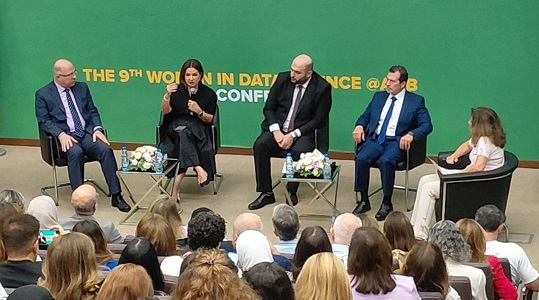
The Union of Arab Chambers participated in the ninth conference of the “Women in Data Science (WiDS)” program, organized by the Suliman S. Olayan School of Business at the American University of Beirut under the title: “Sustainable Reconstruction in Times of Crisis.”
This conference is considered one of the largest regional events affiliated with the global WiDS initiative. It aims to enhance women's participation in the fields of data science and artificial intelligence, and highlight the contributions of female pioneers in this sector from the Arab region and the world.
During the conference, discussions focused on the role of data science and artificial intelligence in supporting sustainable post-crisis reconstruction. Practical applications were also presented in the fields of digital governance, infrastructure, healthcare, and social sustainability. Participants emphasized the importance of strengthening cooperation between the academic and private sectors to empower women in technology and scientific research, and the necessity of exchanging expertise on the use of modern technologies to achieve comprehensive and sustainable economic development.
The conference included a ministerial panel titled: “Digital Transformation in Lebanon: Artificial Intelligence in Governance and Public Services.” The session addressed the potential of employing artificial intelligence to strengthen digital governance, enhance public services, and support data-driven decision-making in Lebanese administration. Sessions also discussed data applications in climate protection, infrastructure sustainability, and the role of artificial intelligence in disaster response, with the participation of experts from the World Bank, UNDP, and international universities. Discussions focused on how to employ data science to strengthen health systems, improve crisis prediction capabilities, and develop decision-support tools in the medical field.
The conference also discussed the importance of building fair and inclusive artificial intelligence systems, and integrating social considerations in designing technological solutions. A parallel session titled “Women, Work, and a Sustainable Future” focused on empowering women in digital work environments and ways to achieve professional equality in the knowledge-based economy.
Outcomes and Key Results:
• Affirming that data science has become a pivotal component of sustainable economic and social development.
• Calling for enhanced integration between academic institutions and the private sector to develop youth and women's skills in the fields of artificial intelligence.
• Highlighting the importance of AI governance and establishing ethical and regulatory frameworks to ensure its responsible use.
• Calling for the development of public policies to encourage investment in digital technologies that support sustainable reconstruction in Lebanon and the region.
• Emphasizing the central role of women in leading digital innovation and technological entrepreneurship.
Source (Union of Arab Chambers)
